Moroccan black soap and rhassoul: the hammam ritual at home
By Souvenir Express team · Published 17 November 2026
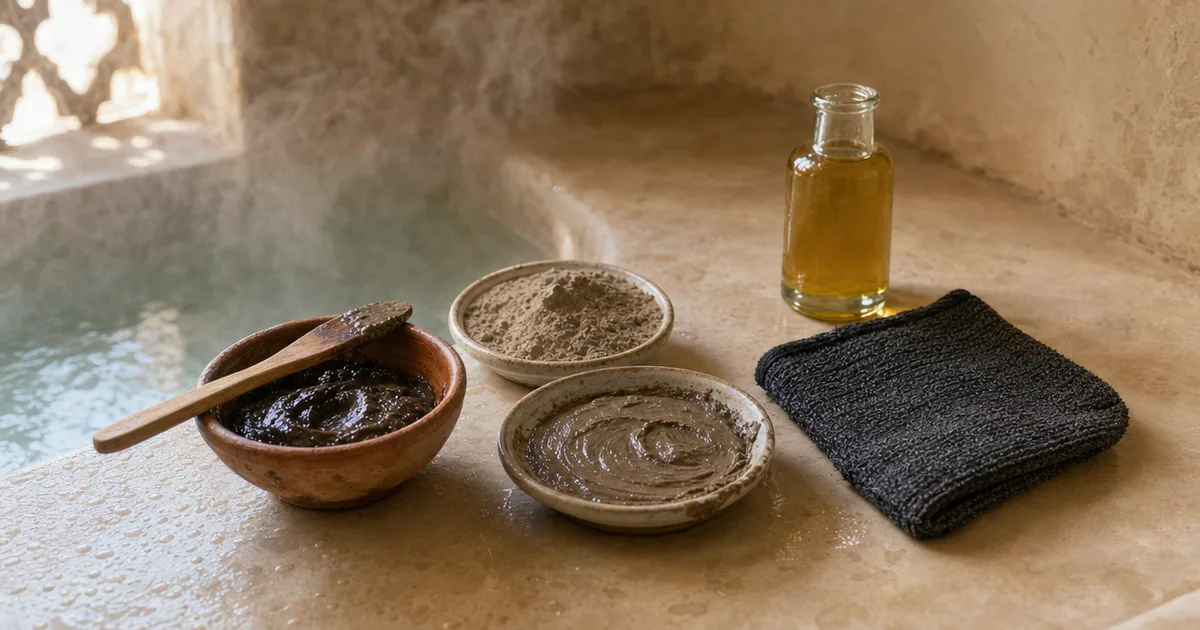
Moroccan black soap and rhassoul are the two steps of the hammam. Black soap, a soft paste made from olive oil, prepares the skin for scrubbing; rhassoul, a clay mined in the Moulouya valley, cleanses skin and hair. A few drops of argan oil often close the ritual, and all three now have a place in bathrooms well beyond Morocco.
Here is what sets them apart, how to use them, and the sets in our selection that let you try them or give them.
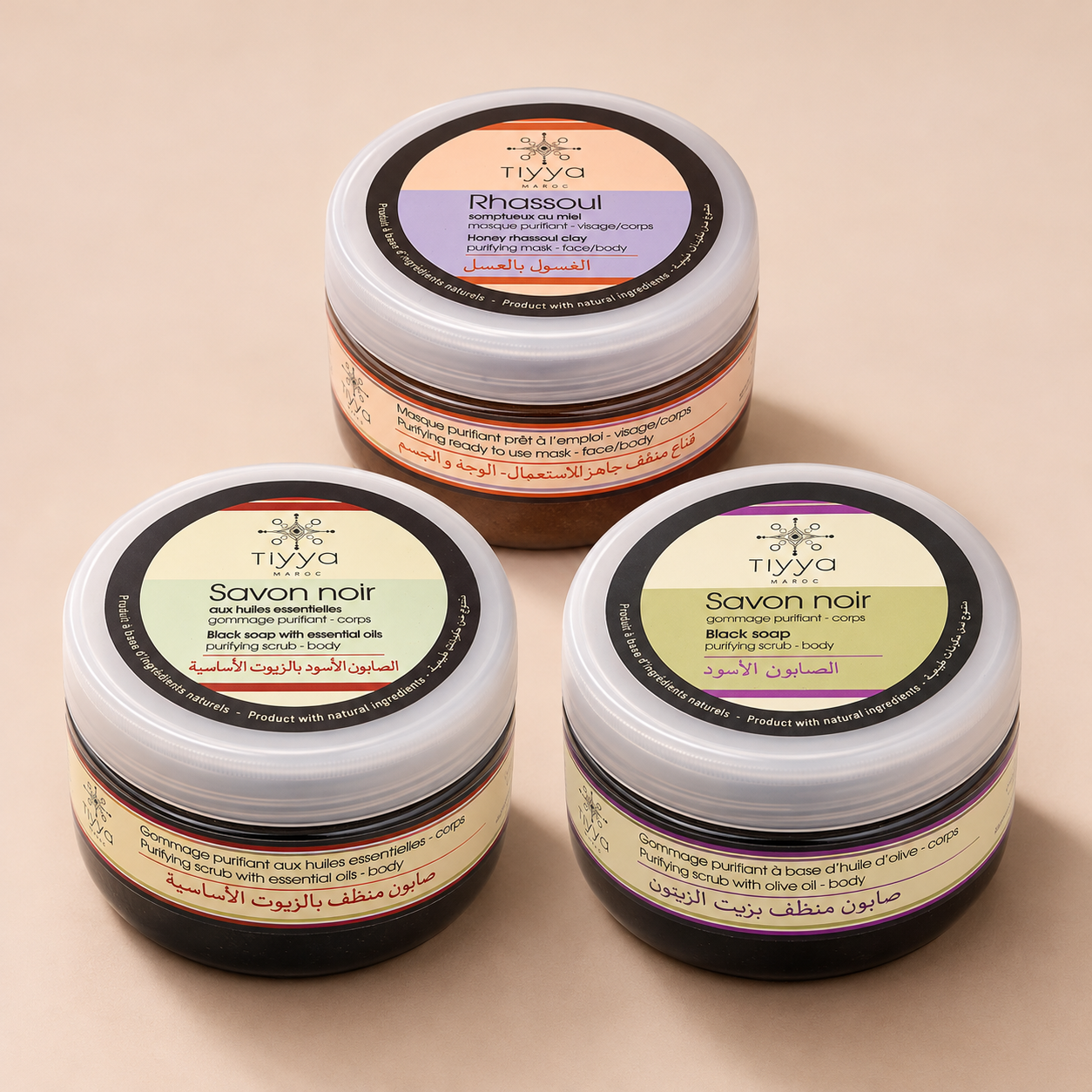
Trio Hammam Essentials
Hammam gift set: two black soaps and honey rhassoul
170 MADView
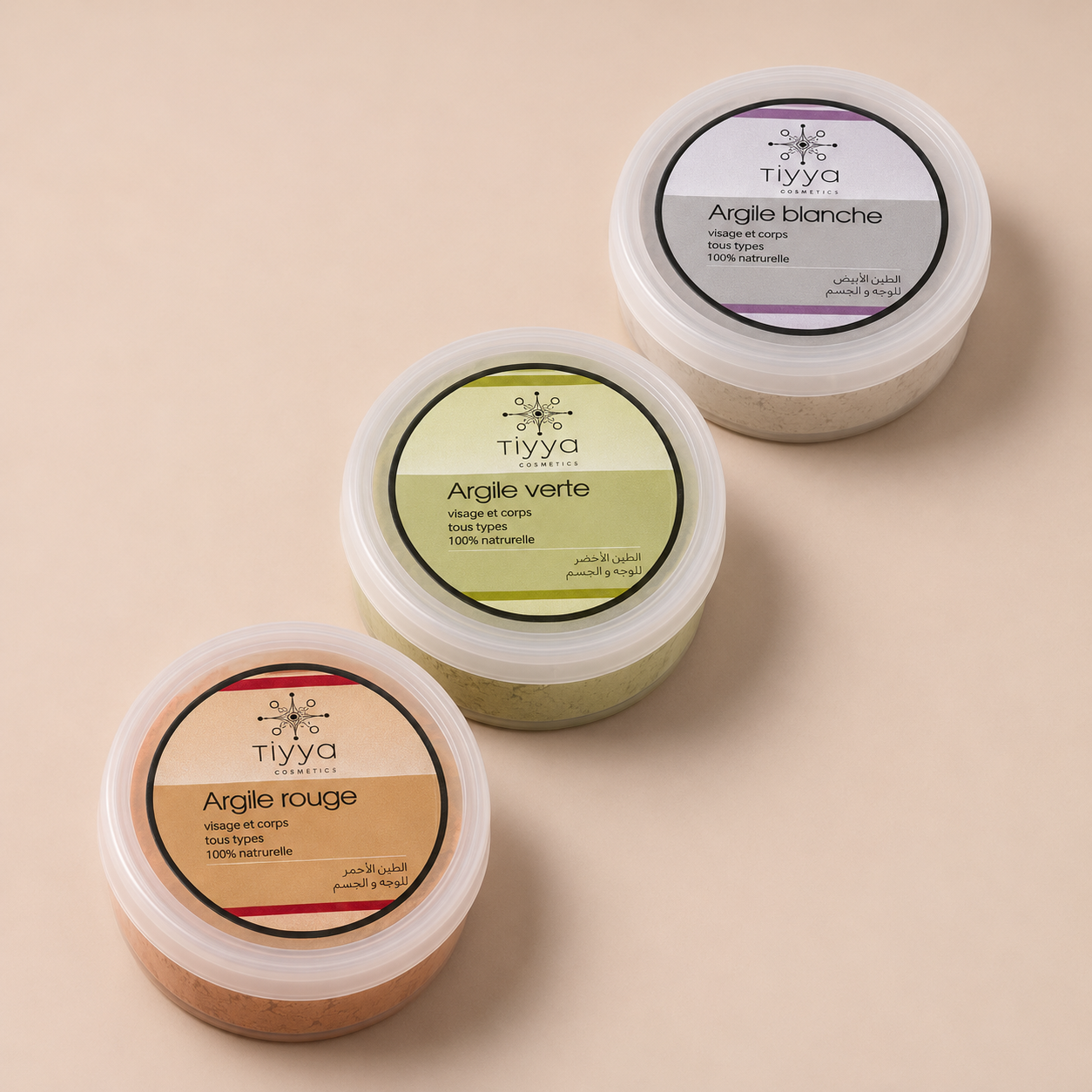
Set of 3 Mini Clay Powders
Set of 3 mini Moroccan clays: red, green and white
150 MADView
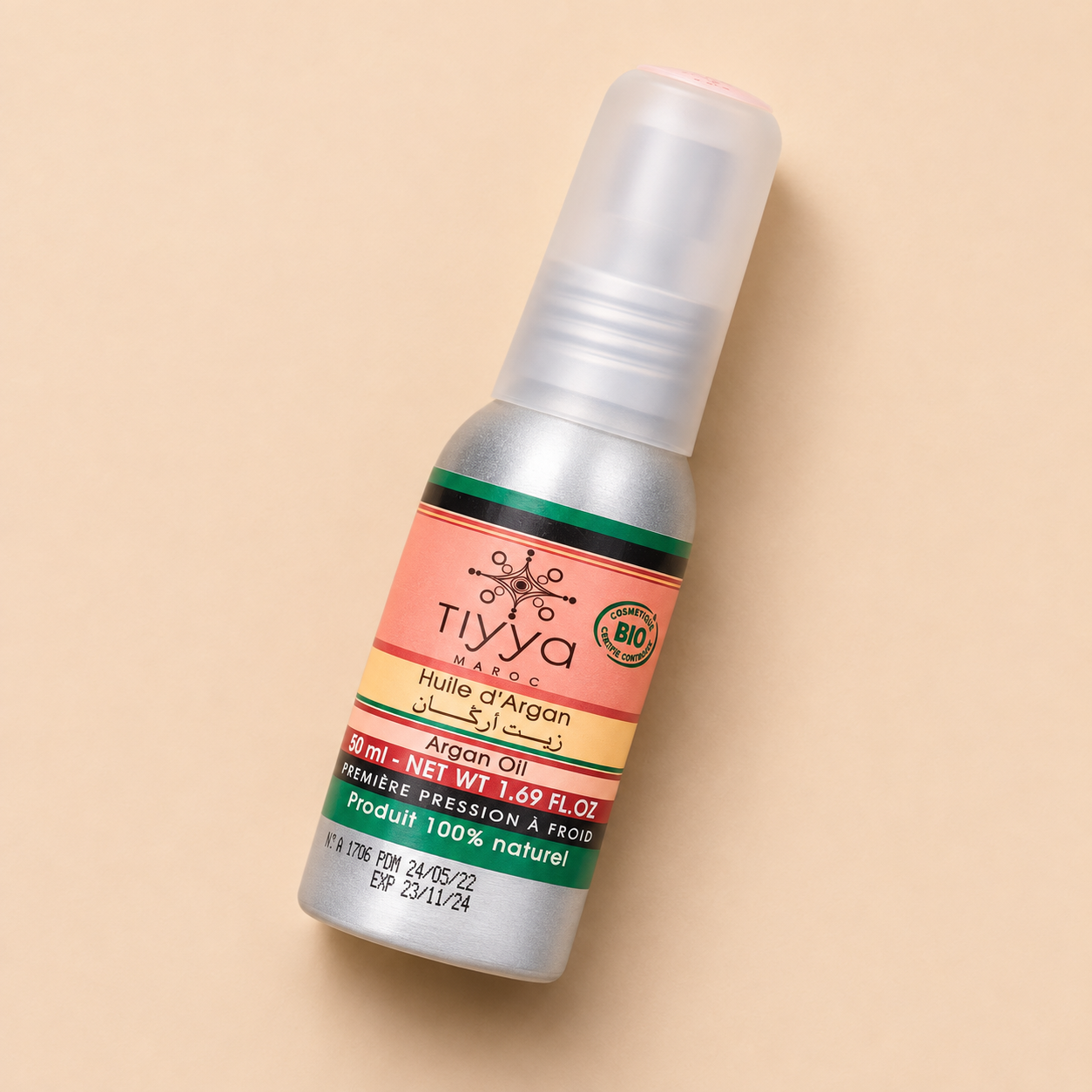
Organic Argan Oil
Pure organic argan oil from Agadir, first cold pressing
130 MADView
Want one of these, or a question first?Order on WhatsApp
What is Moroccan black soap?
Black soap, known in Morocco as savon beldi, is not a bar. It is a soft, dark brown paste with a green tint, made from olive oil and crushed black olives saponified with potash. That plant base gives it a balm-like texture that spreads easily on wet skin.
In the hammam it comes after the heat. It goes on damp skin, rests for a few minutes, then is rinsed off before the scrub. Resting times vary from one person to another; a few minutes is usually enough.
Our Trio Hammam Essentials brings together two 240 g black soaps: a traditional olive oil soap, and a second one with rosemary, eucalyptus and petitgrain essential oils for a fresher feel.
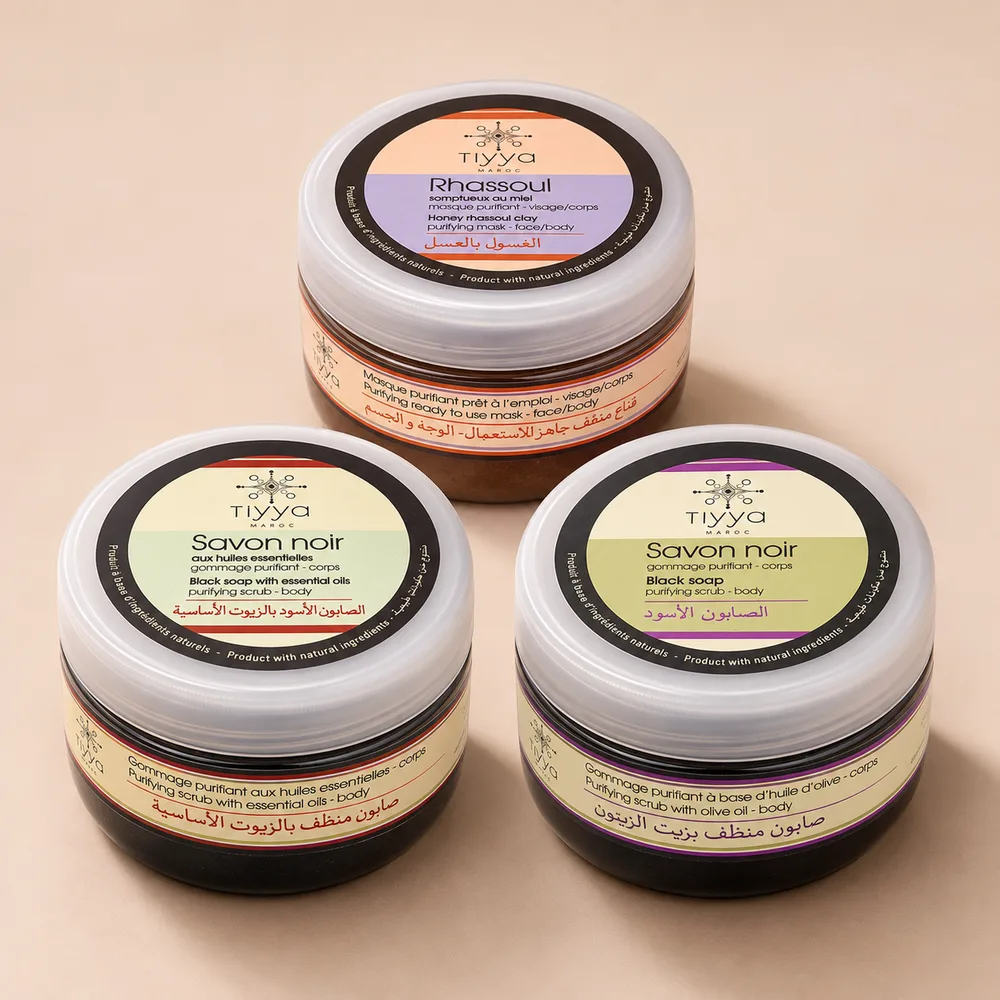
Why choose it? To bring the first step of the hammam home, with two scents to alternate.
Rhassoul, a clay from the Moulouya valley
Rhassoul, also spelled ghassoul, comes from a deposit on the eastern side of the Middle Atlas, in the Moulouya valley, about 200 km from Fez. It is the only mined deposit of this magnesium- and silica-rich clay, which geologists call stevensite.
It is mixed with water, sometimes with flower water, into a smooth paste that goes on the skin or hair before rinsing. In many families it is also part of the bride's hammam in the days before a wedding.
The Trio Hammam Essentials includes a 290 g honey rhassoul, used as a mask to purify and soften the skin.
Why choose it? It is a material tied to one precise place in Morocco, and a simple treatment to prepare.
Trio Hammam Essentials
Hammam gift set: two black soaps and honey rhassoul
170 MADView
Set of 3 Mini Clay Powders
Set of 3 mini Moroccan clays: red, green and white
150 MADView
Organic Argan Oil
Pure organic argan oil from Agadir, first cold pressing
130 MADView
Want one of these, or a question first?Order on WhatsApp
How do you use black soap and rhassoul at home?
The ritual takes five steps, in the shower or the bath. Hot water stands in for the hammam's heat: it softens the skin and makes the scrub gentler.
| Step | What you do | Product |
|---|---|---|
| 1. Heat | A few minutes under hot water, or in a steamy bathroom | – |
| 2. Black soap | Apply a small amount to wet skin, leave for a few minutes, rinse | Traditional or essential-oil black soap |
| 3. Scrub | Rub the skin with a kessa glove in circular motions | Kessa glove |
| 4. Rhassoul | Mix the clay with a little water, apply as a mask to body, face or hair, rinse | Honey rhassoul |
| 5. Nourish | A few drops of oil on still-damp skin or hair ends | Argan oil |
The kessa, a glove of rough fabric, is the tool of the Moroccan scrub. Black soap goes with it: applied just before, it prepares the skin for that step.
Red, green or white clay: which one to choose?
Three clays come up again and again in beauty rituals, each with its own use. Green clay is the most absorbent and suits combination to oily skin. White clay is gentler and suits sensitive skin. Red clay is chosen for masks that bring back radiance.
Our Set of 3 Mini Clay Powders brings these three natural clays together in a small format: red for radiance, green to purify and rebalance, white to soothe and soften. The size lets you try each one before settling on the clay that suits your skin, or take them travelling.
Why choose it? To build your own ritual around your skin, or to give someone a first introduction to clays.
Argan oil, the last step
The argan tree grows in south-west Morocco, around Agadir and Essaouira. Its oil often ends the hammam ritual: a few drops on still-damp skin, on the ends of the hair or on the nails.
Our Organic Argan Oil comes from the Agadir region. It is first cold pressed and used on skin, dry hair and brittle nails.
Why choose it? To extend the care after rinsing, with a product closely tied to southern Morocco.
The hammam, part of Moroccan life
In Morocco, the neighbourhood hammam is a meeting place as much as a place to wash. Families have traditionally gone every week, often for several hours, moving from the warm room to the hot room, washing, scrubbing and talking.
Hotels and spas also offer more private hammams, where the ritual is guided from start to finish. Black soap, the kessa glove and rhassoul keep the same place there.
Taking these treatments home keeps a little of that time: a weekend ritual, slower than a shower, built around materials from Morocco.
Which hammam gift set should you give?
The choice depends mostly on how well the person already knows the hammam.
| For | Our suggestion |
|---|---|
| Someone discovering the ritual | The Trio Hammam Essentials, with both black soaps and the rhassoul |
| Someone attentive to their skin | The Set of 3 Mini Clay Powders, to find the clay that suits them |
| Someone who travels often | The small-format clays, easy to slip into a wash bag |
| A fuller gift | The Trio Hammam Essentials with the Organic Argan Oil |
During a stay in Morocco, these treatments also make a thoughtful gift for a host or for someone who welcomes you.
With Souvenir Express
Orders are packed ready to give and delivered free within 24 hours anywhere in Morocco, to a home, an office or a hotel reception. An express option delivers in under an hour, for a fee shown at checkout.
You pay on delivery, or finish your order on WhatsApp. A product can be returned within 7 days of delivery: we come and collect it free of charge.
Discover our selection of Moroccan rituals
FAQ
How do you use Moroccan black soap?
Apply it to wet skin after a few minutes of heat, leave it for a few minutes, rinse, then scrub the skin with a kessa glove in circular motions.
How long should black soap stay on the skin?
A few minutes is usually enough. Habits vary from person to person and from one hammam to another.
What is the difference between black soap and rhassoul?
Black soap is an olive oil paste that prepares the skin for scrubbing. Rhassoul is a clay from the Middle Atlas, used afterwards as a mask for the skin or hair.
Can rhassoul be used on hair?
Yes. Mixed with water, it goes on the hair and scalp like a mask, then is rinsed out.
Can you take black soap in hand luggage?
In the cabin, a paste counts as a liquid: a 240 g tub is over the 100 ml limit and goes in checked baggage. Rhassoul and powdered clays are not affected by that limit.